OpenClaw and IP Proxy: The Compliance and Efficiency Debate in Cross-border SaaS Operations in 2026
IP tốc độ cao dành riêng, an toàn chống chặn, hoạt động kinh doanh suôn sẻ!
🎯 Trải Nghiệm Ngay - Không Cần Thẻ Tín Dụng⚡ Truy Cập Tức Thì | 🔒 Kết Nối An Toàn | 💰 Miễn Phí Mãi Mãi
Phủ Sóng Toàn Cầu
Tài nguyên IP bao phủ hơn 200 quốc gia và khu vực trên toàn thế giới
Cực Nhanh
Độ trễ cực thấp, tỷ lệ kết nối thành công 99,9%
An Toàn & Bảo Mật
Mã hóa cấp quân sự để bảo vệ dữ liệu của bạn hoàn toàn an toàn
Đề Cương
OpenClaw and IP Proxy: The Compliance and Efficiency Debate in Cross-border SaaS Operations in 2026
In the global SaaS landscape of 2026, the concept of “OpenClaw” is frequently discussed. It does not refer to a specific software or protocol, but rather an idealized operational model: a business that operates like an open, flexible claw, capable of seamlessly reaching any market around the world, capturing data, managing accounts, and providing services without being restricted by geography, platform, or policy. For many SaaS companies aiming for global expansion, this is undoubtedly an attractive vision. However, when this ideal meets reality, the first challenge is how to handle the fundamental and critical issue of “IP identity” in a safe, stable, and compliant manner.
The Gap Between Ideal and Reality: IP Dilemmas Under the OpenClaw Model
The core of the OpenClaw model lies in “seamless access” and “local simulation.” Whether it’s conducting multi-region A/B testing, managing a dispersed social media matrix, monitoring global competitors’ dynamics, or providing localized service experiences to users in different regions, all require a robust underlying support that can accurately simulate the network environment of the target region. This is far beyond what a simple VPN or regular proxy can achieve.
Many teams underestimate the complexity of the IP environment in the early stages. They may use data center IPs for large-scale data collection, only to quickly face rate limits or even bans from the target servers. Or they may use mixed-source proxies to manage overseas accounts, leading to account lockouts due to “abnormal login locations.” The root of these problems lies in the fact that modern internet platforms’ risk control systems have become highly intelligent, capable of accurately identifying machine traffic and real users through multi-dimensional data such as IP type, historical behavior, and correlation. A single misstep can cause a carefully planned global operation strategy to collapse.
Therefore, achieving OpenClaw does not mean a brute-force technological breakthrough, but rather a more refined and realistic network ecosystem strategy. This leads to a deep reliance on professional IP proxy services.
Professional Proxies: From Cost Center to Strategic Enabling Tool
In the past, IP proxies were often seen as a simple “tooling expense” or technical cost. However, in current operational practices, their role has evolved into a key “strategic enabling layer.” A high-quality global IP proxy service must meet at least several core conditions: high levels of anonymity and purity, extensive global coverage and precise geographic positioning, and high stability and availability.
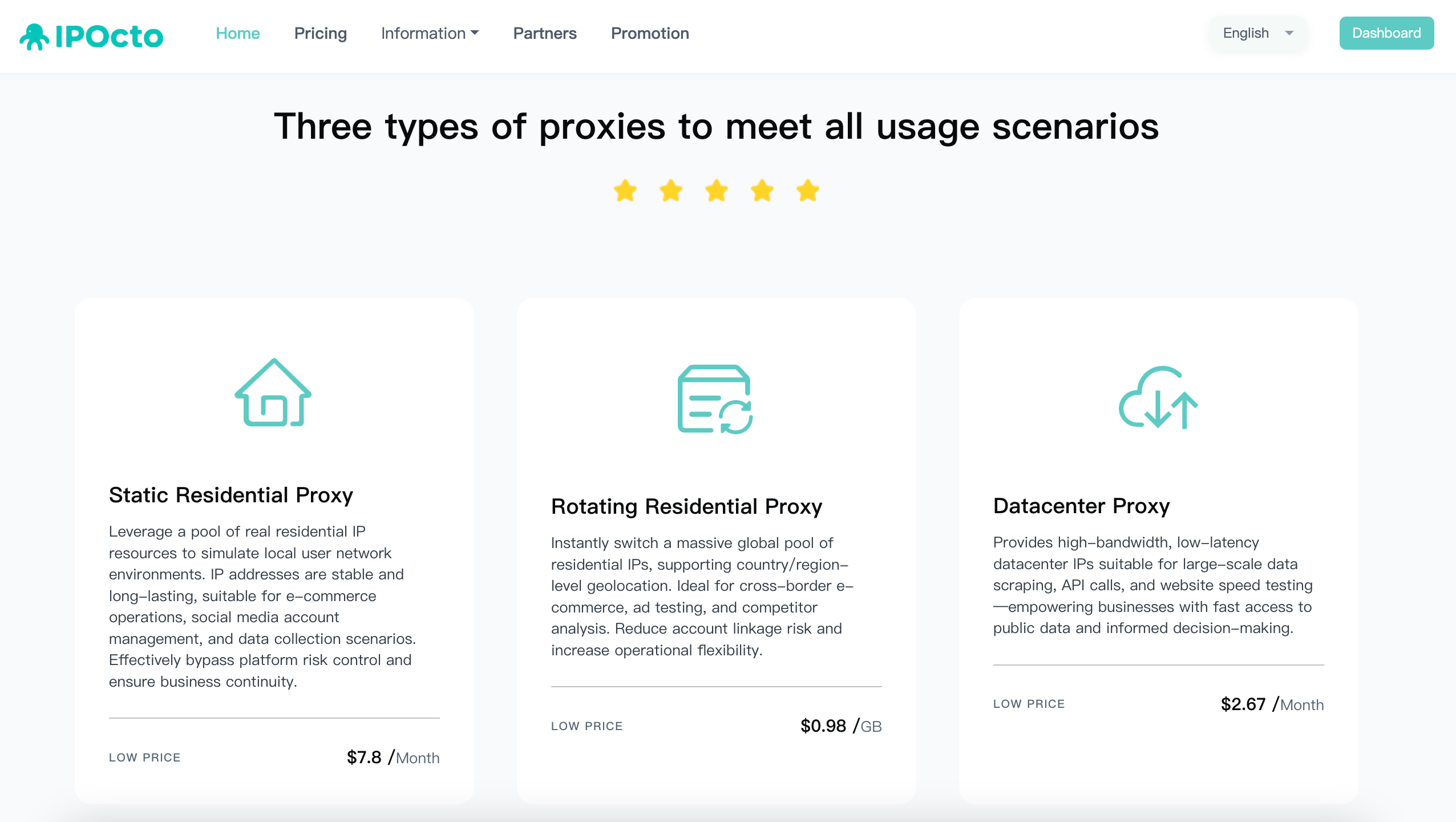
For example, when managing a SaaS product’s social media matrix covering North America, Europe, and Southeast Asia, the operations team needs to ensure that each regional account logs in and operates from a local, stable residential IP. If the IP frequently changes or the quality is poor, it not only triggers platform risk control but also harms the account’s weight and content recommendations. At this point, the value of static residential proxies becomes evident. They provide long-term stable real residential IPs, perfectly simulating local residents, and are the cornerstone for maintaining account health and conducting in-depth community operations.
On the other hand, for tasks such as market research and competitor analysis that require extensive and rapid collection of public information, rotating residential proxies are more efficient. They can switch massive IP addresses on demand and by region, accessing data in a distributed and realistic user-like manner, significantly reducing the risk of a single IP being blocked and improving the breadth and success rate of data collection.
In terms of technical architecture, for example, when conducting global API call testing or deploying distributed service nodes, high-bandwidth, low-latency data center proxies can provide strong performance support, ensuring the smooth execution of core business logic.
In practice, teams are increasingly inclined to choose service providers that offer a one-stop solution for multiple proxy types, cover global nodes, and provide convenient integration and management. This effectively reduces the complexity of the technical stack, allowing teams to focus more on business logic itself. For example, some service providers like IPOcto offer a combination of static residential, rotating residential, and data center proxies, supporting precise positioning at the country, city, and even carrier level. This allows operations and development teams to quickly match the most suitable IP resources for different business scenarios (such as e-commerce operations, social media management, and data collection). Their claimed “5-minute rapid deployment” and “pay-as-you-go” model have indeed lowered the initial barriers and long-term costs of global business trials and expansion in practice.
Compliance and Ethics: The Unavoidable Boundaries of OpenClaw
Pursuing technological “openness” and “flexibility” must not come at the cost of compliance and business ethics. This is a general consensus in the industry in 2026. The use of IP proxies must strictly follow several principles:
First, respect the service terms of the target website. Even with the best proxies, it should not involve brute-force crawling that could overload the other party’s server or bypass their explicit access restrictions.
Second, protect user privacy and data security. All data obtained through proxies must comply with global major data protection regulations such as GDPR and CCPA in terms of storage, processing, and use.
Finally, clear business purposes. IP proxies should be used for legitimate commercial intelligence analysis, market research, and local service optimization, not for fraud, fake clicks, or other malicious activities.
Professional IP service providers usually ensure the “cleanliness” of their IP pools through strict screening and maintenance, and establish clear usage guidelines. As a user, SaaS companies should also establish internal usage approval and audit processes, integrating IP resource management into the overall risk control system.
Future Outlook: Deep Integration of IP Intelligence and Business Flow
Looking ahead, the maturity of the OpenClaw model will not depend on more “invisible” IP technology, but rather on the deep, automated integration of IP management intelligence and SaaS business flow. We may see:
- The emergence of a strategy engine: The system can automatically select the optimal proxy type, IP switching frequency, and access rhythm based on task types (such as login, posting, data scraping), the risk control level of the target platform, and the required region.
- Dynamic risk coordination: IP proxy services can be integrated with the account health monitoring system on the business side. When an account is detected to have an abnormal risk, it can automatically switch to a safer and more stable IP environment.
- Real-time optimization of cost-effectiveness: The system can dynamically adjust resource allocation based on the actual success rate, speed, and cost of each proxy channel, achieving the optimal balance between operational efficiency and cost.
At that time, IP proxies will truly become an invisible yet extremely solid and reliable “digital foundation,” supporting the flexible and stable operation of OpenClaw in global markets.
FAQ
Q1: For a startup SaaS company, how can it start building global IP capabilities at a lower cost?
A1: It is recommended to start with service providers that offer on-demand payment or free trial quotas. First, clearly define the core business scenarios (such as market research or social media testing), and choose the most suitable proxy type (such as rotating residential proxies for data collection), and validate the effect on a small scale. Avoid investing a large amount of money in fixed packages at the initial stage.
Q2: Does using a residential proxy guarantee safety and prevent being banned?
A2: Not necessarily. Although residential proxies simulate a real user environment, if the usage behavior is abnormal (such as an excessive number of requests or operations that violate platform rules), they can still be identified and banned. The key is to simulate the access patterns of real human users and comply with platform rules.
Q3: When managing businesses in multiple regions, how can different IP resources be effectively organized and isolated?
A3: Many professional proxy services provide authentication systems based on users or projects, which can assign independent proxy channels and IP segments for different teams, projects, or regions. This not only achieves resource isolation but also facilitates subsequent cost accounting and access auditing.
Q4: Besides technical selection, what should the team pay attention to when using IP proxies internally?
A4: It is necessary to establish clear usage policies and training mechanisms to ensure that all members understand the importance of compliant usage. At the same time, it is recommended to centrally manage proxy accounts and resources to avoid scattered usage leading to cost control issues or security risks, and to regularly audit usage logs.
🎯 Sẵn Sàng Bắt Đầu??
Tham gia cùng hàng nghìn người dùng hài lòng - Bắt Đầu Hành Trình Của Bạn Ngay
🚀 Bắt Đầu Ngay - Trải Nghiệm Ngay